Dual Vacuum Plug Design
- Remove output hose from amplifier (EGR valve-to-vacuum amplifier hose) and connect hose to vacuum gauge. See Fig 2. Remove reservoir vacuum hose and "T" it with the source vacuum line.
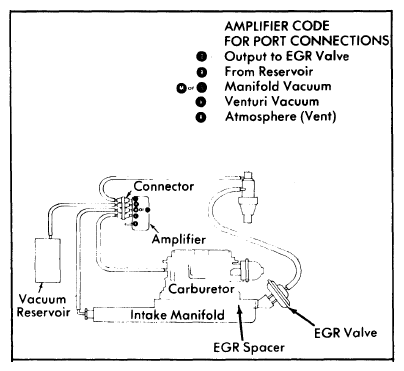 Courtesy of FORD MOTOR CO.
- Momentarily increase engine speed to 1500-2000 RPM. With engine at idle, remove vacuum hose at carburetor venturi. Vacuum gauge reading should be within 0.3 in. Hg of bias value. If not, replace vacuum amplifier.
- Depress accelerator pedal and release after engine speed has reached 1500-2000 RPM. If vacuum gauge shows an increase of 1 in. Hg or more during acceleration, replace vacuum amplifier.
- Connect venturi hose to carburetor. If vacuum gauge reading increases more than 0.5 in. Hg, check idle speed and correct if necessary. Rapidly increase engine speed to 1500-2000 RPM and note vacuum reading. Vacuum should increase above 4 in. Hg during acceleration and return to specified bias at idle. If not, replace vacuum amplifier.
- Connect vacuum reservoir port of vacuum amplifier to manifold vacuum, "S" port to spark port vacuum, "V" port to venturi vacuum, and "C" port to a vacuum gauge.
- Increase engine speed to 1500-2000 RPM and allow engine to return to idle. Remove vacuum hose at venturi and check spark port vacuum. Vacuum gauge should read less than 0.5 in. Hg. If not, replace vacuum amplifier.
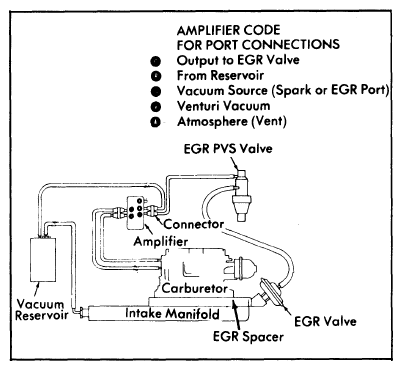 Courtesy of FORD MOTOR CO.